
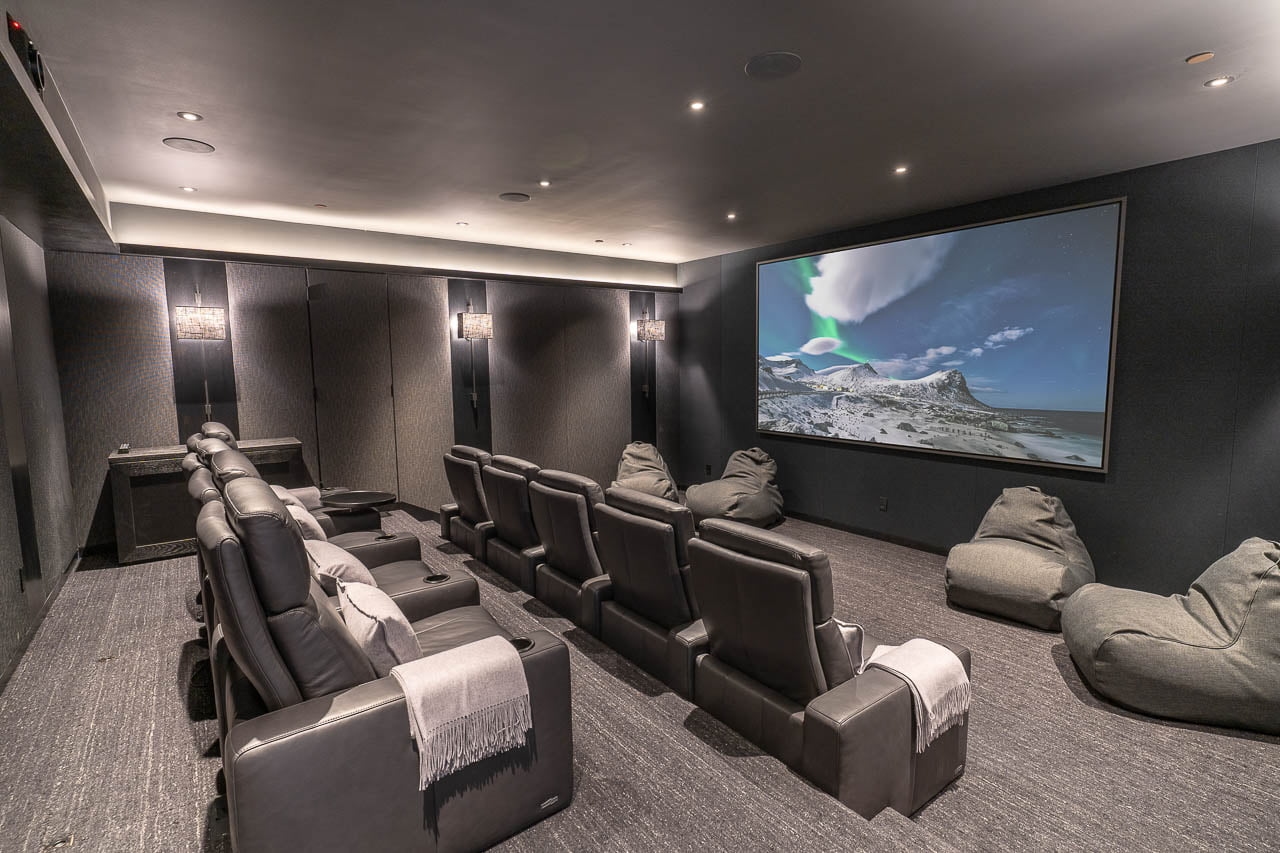
A dedicated home cinema is an incomparable sanctuary. The subtle nuances in the audio, the clarity of instruments, the way you can hear objects move around the room, and the vividness of the picture make the experience like nothing else out there.
If you’ve never been in a dedicated home cinema, it’s unlike anything a public theater could offer. It comes down to four elements: the overall room, the sound treatment, the screen, and the projector. So what details make a dedicated home theater so coveted?
Sound Isolation and Treatment: The Foundation of a Dedicated Home Theater
While visuals can feel like the center stage of a home theater, great audio is the secret sauce to a great theater experience. The backbone of a great audio system is a properly designed room, with insulation and isolation in the perfect places.
Running Audio Simulations
That means we digitally create the room, we place our speakers and preferred sitting areas, and we mimic the room dimensions. After reviewing the simulation, we determine what parts of the room should be treated to ensure an acoustically perfect space. In doing so, we have complete control of the audio in the room. There are two primary goals in this process: maximum control over how sound moves in the room, and minimizing the intrusion of outside sounds.
Controlling How Sound Moves In The Dedicated Theater
While speaker placement can move the sound source, acoustical treatment controls how sound moves around the room. When sound waves bounce off walls or other hard surfaces, they can create echoes. Echoes are the result of sounds bouncing off a surface and returning to your ear. It repeats the same sound in a delay.
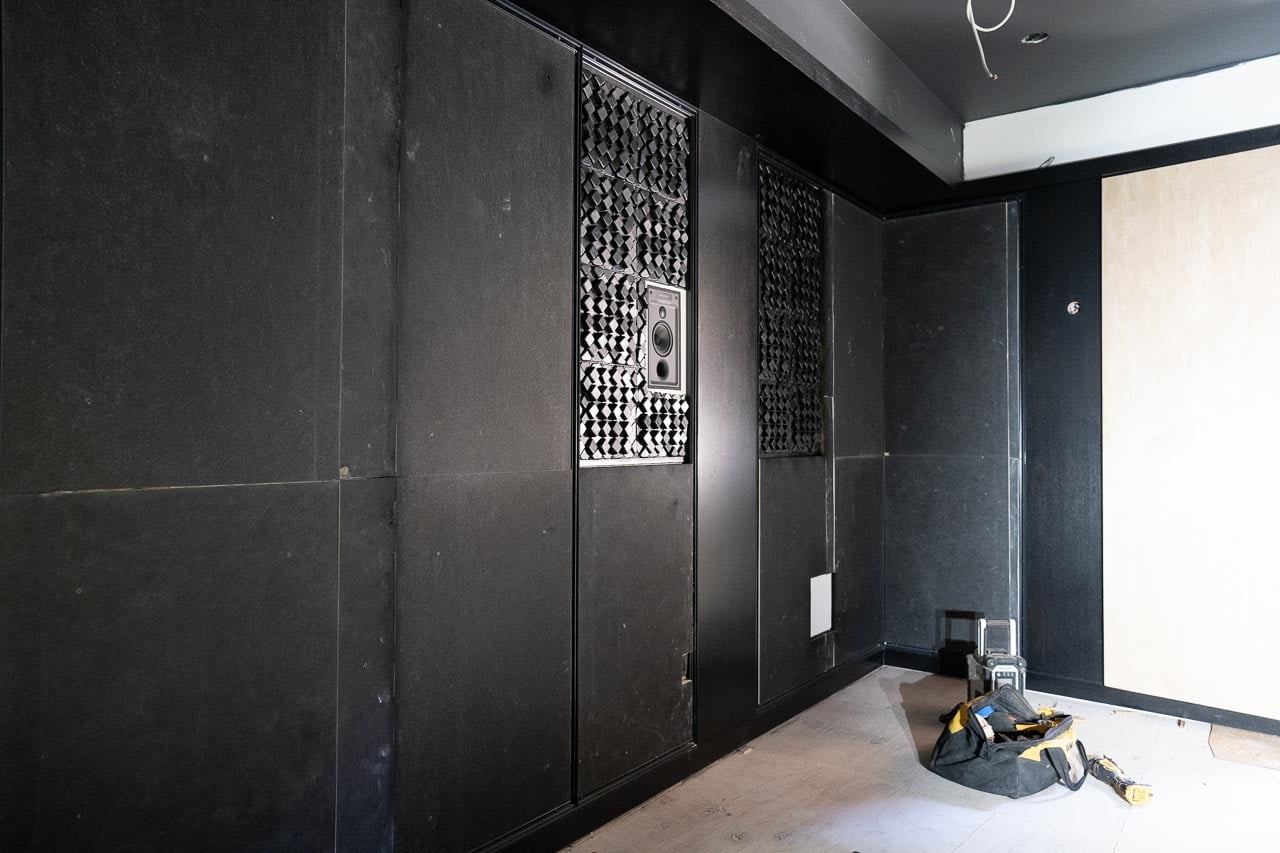
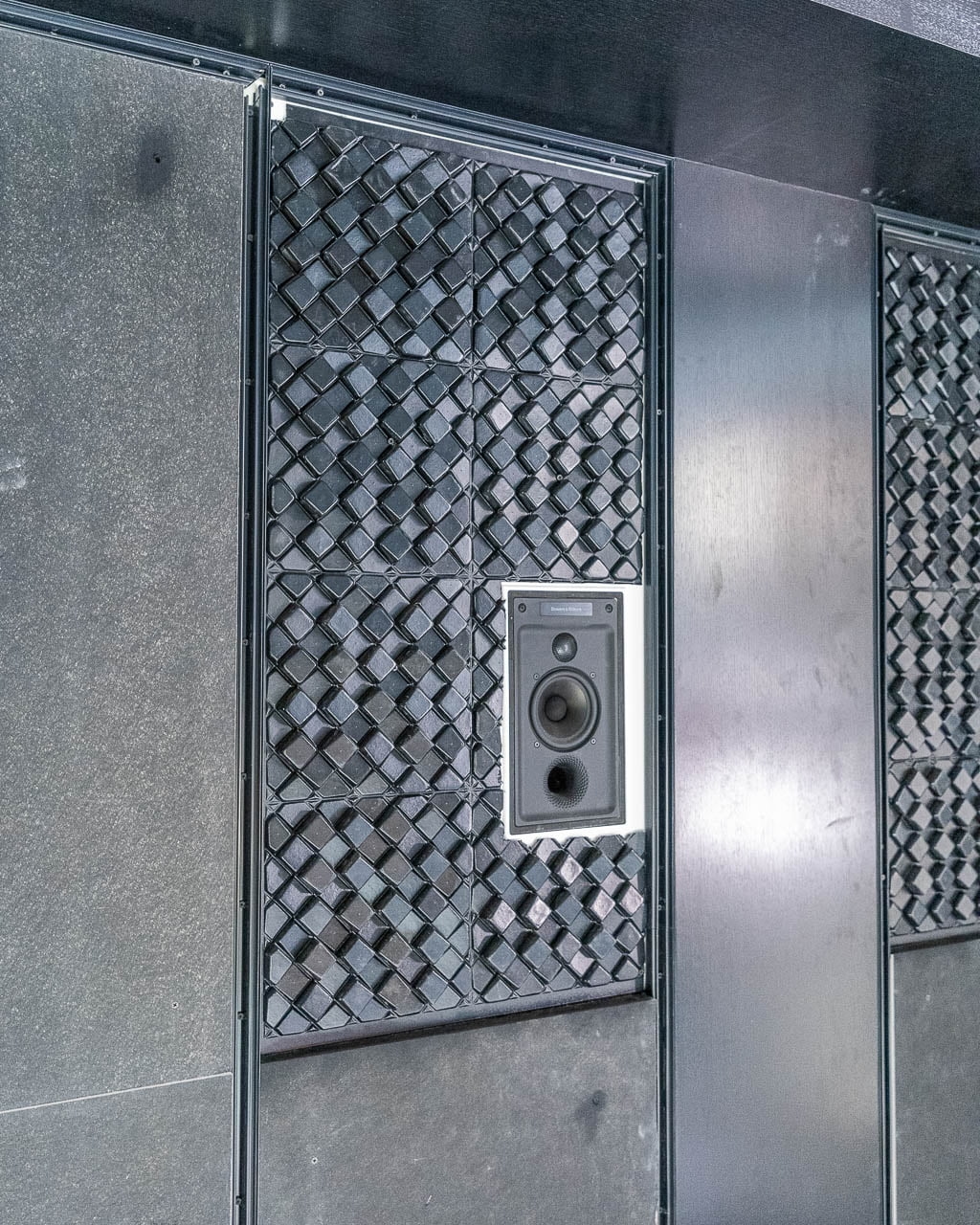
To minimize this effect, we install a special sound treatment on all the walls to reduce echoes at all frequencies. We cover this treatment with a sound-passive fabric to hide it in plain sight.
Thanks to audio simulations, we can strategically apply acoustic treatments in the room to maximize their effectiveness. This reduces echoes and minimizes the impact of reflections, ensuring a pure and immersive auditory experience just as the director intended. Additionally, we have multiple sound treatment methods. We can use materials to absorb the sound so it doesn’t reflect. Alternatively, we can use diffusion treatments to spread the sound so that it decreases the volume of sounds bouncing off a wall.
This is a delicate balance, because too much sound isolation will create a “dead room.” If you’ve never experienced this effect, it feels as if the deadening is pulling the sound out of the room, since none of it is reflected.
We also strongly prefer carpets for the floor because softer surfaces are less likely to promote echoes. We have a great demo of this phenomenon at our design center in Novato, CA.
Isolating Outside Sounds For a Quieter Theater
Hearing background sounds from real life during a film can break the illusion of being in a movie. It doesn’t matter if no one else is home making noise — even something as subtle as your HVAC fan can be distracting. To combat this, we strategically design the space to keep ambient sounds outside the theater to create a quieter environment.
Lowering the Noise Floor
The noise floor is the volume of ambient sound in a room. It’s the wind noise in your car on the highway. It’s the sound of the kitchen and surrounding guests at a restaurant. When we lower the noise floor to a low level, you lend your ears to every sound from the movie. This is called decoupling. It allows the director to deliver their intended impact of hearing someone whisper something on camera, yet hear the volume and intensity of an explosion.
When it comes to a dedicated theater, the noise floor can be raised by wind, noise bleeding through walls from other rooms, fans from equipment, and even things as quiet as your HVAC system. The lower the noise floor, the better you can hear the quieter parts of a movie — and the fewer distractions there are pulling the viewer out of the moment.
To minimize the noise floor, we have to isolate the room from these undesirable sounds. That means tons of soundproofing on every wall, and even the ceiling if there’s a floor above the theater. Even the light back boxes need a soundproof enclosure to seal them off from outside the room. Failing to soundproof every part of the room defeats the entire purpose. Soundproofing is only as strong as the weakest part.
The next piece is minimizing the sounds of anything in the room. The HVAC system has to come into consideration. The angle the air comes in, the size of the opening, how close the vent is to the wall, and the velocity of the air all come into play with how loud the system is. We design the dedicated theater HVAC system to minimize these sounds.
The final piece to consider when lowering the noise floor is the A/V equipment. A lot of warm equipment requires adding fans that make noise. Some equipment makes some noise just while running and being on. These items would raise the noise floor. Whenever possible, we relocate all the equipment to a centralized rack so that no equipment in the room generates noise.
Bringing The Best Audio System For Movies. Period.
This isn’t just the best you can have in a home, it’s the best you can have for movies, period! While speakers do play a big role, the layout is a big piece of it.
Speaker Placement to Create 3D Sound
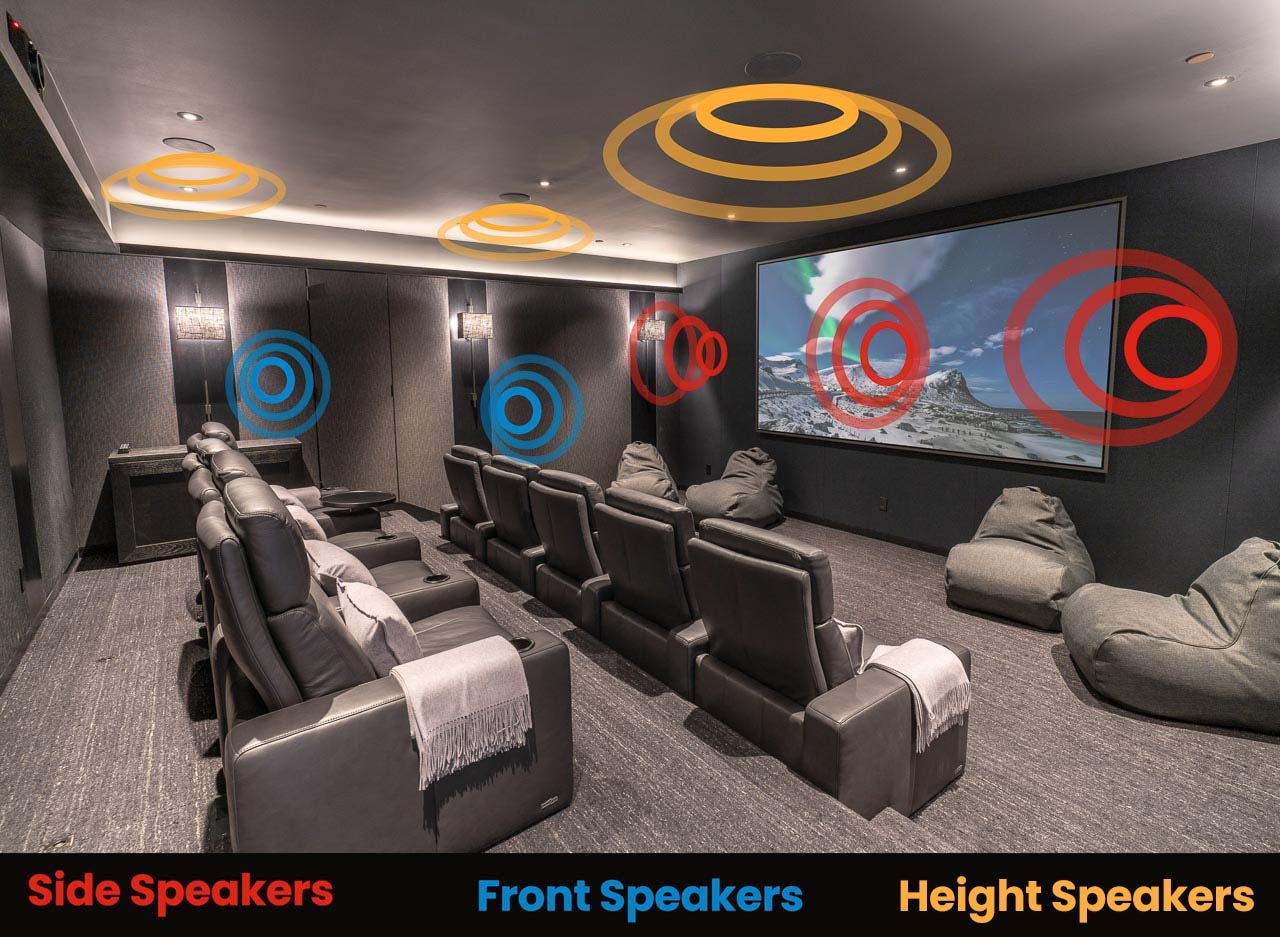
You read that right. With the right layout, we can manipulate the speed of sound with your setup to place sounds in your space. You may have heard of a 5.1 system: a front left, front center, front right, rear left, rear right, and subwoofer system. Unfortunately, this system only brings audio on a horizontal plane. Our dedicated theater systems create sounds in a 3D space, with height, thanks to a system called Dolby Atmos.
Dolby Atmos revolutionizes the traditional surround sound experience by incorporating speakers not only around the viewer but also above. This provides an immersive audio experience like never before. By intelligently delaying a single sound at different intervals from different speakers, your theater system will create sounds in 3D space. And don’t worry; this is all done with SoundVision’s unique programming.
To ensure the best possible experience, our speakers are intelligently placed depending on where people usually sit.
The Symphony of Great Audio: What to Expect
Great audio means that when you watch Top Gun: Maverick, you feel the jets on the runway in your chest instead of just seeing them on the runway. You can faintly make out whispers from people behind the camera, yet still feel the volume of an explosion during an action scene. In movies like The Great Gatsby, the rich tones of the vocals, the subtle nuances of each instrument, and the reverberation of the ambient sounds are not just heard but felt, creating a sonic tapestry that transports you into the heart of the scene.
Speaker Placement Decided By The Sitting Position
This level of engagement isn’t achieved by placing speakers randomly; instead, it is meticulously crafted. The speakers are precisely placed based on where you’re sitting in the room. The volume of each speaker is independently tuned so that it is consistent and well balanced. All the speakers go through a sophisticated calibration process to ensure a quality Dolby Atmos experience and to ensure the equalization is balanced. The speakers and amplifiers themselves are selectively chosen for your specific space and preferences to give you maximum dynamic range and to reach the volumes you want.
Backed By The Best Speaker Layout
To achieve this experience, we start with the basics. Most people have heard of a 5.1 sound system: three speakers in the front for the front left, front center, and front right, and then two more at the sides. That point one represents the subwoofer. Then there’s 7.1, which adds two more left and right speakers, to have both side and rear speakers.
Dolby Atmos: Placing Sound in a 3D Space
The step to Dolby Atmos removes the restriction of having your audio on one plane. We are able to do this by putting speakers in the ceiling. Pairing these ceiling-mounted speakers allows us to calibrate the entire suite of speakers with a series of microphones around where the user sits.
In this test, it measures how long the delay is between when a speaker is told to play a sound and when it is measured by the microphone. All of these are recorded and used to understand the time it takes for that sound to travel, along with general system calibration. Then, we can use this information to manipulate the delays so that the speakers all collide at unique places in the room that aren’t where the user is sitting. This illusion makes it sound like sounds aren’t coming from left and right, but from a pinpointed space in the theater! When SoundVision calibrates your dedicated theater, your equipment will do this automatically in real time. If you have never heard a dedicated theater in person, you should come to our showroom and experience it yourself!
Bass Placement: Careful Consideration For All Watching
Finally, the bass speakers are strategically placed. Bass sound waves are super long, so the subwoofers must be strategically placed to prevent constructive or destructive interference while also ensuring they are an equal volume for everyone watching. It’s the combination of selecting, placing, and calibrating equipment that separates professionally crafted theaters from the rest. The experience is unlike anything else.
A Picture-Perfect Display: Source, Projectors and Screens
As impressive as audio can be, in a theater it is only as good as the picture to accompany it. There are two primary pieces to a beautiful picture: the projector and the screen. However, large-scale TVs are increasingly becoming a viable option with minimal sacrifice to picture quality or size. Whichever you choose, the source matters just as much — see why we put Kaleidescape on every high-performance system we install.
Acoustically Transparent Screen
The screen introduces a unique problem. For maximum fidelity, we prefer to have your speakers at ear height. Meanwhile, we also want the center of the screen to be at eye level. This means we want your screen and front speakers to be the same height. To accomplish this, we use an acoustically transparent screen.
Acoustically transparent screens are made of a unique perforated woven material that allows sound to pass through seamlessly. This allows us to put your front center speaker behind the screen, keeping it at the appropriate height while not sacrificing picture quality.
Picking a Screen Size, Type and Placement That Fits the Space
The viewing experience is more straightforward than the audio system but just as important. It’s easy to overlook the importance of a quality screen. With a private theater, the only decision to be made is if you want an acoustically transparent screen. Acoustical transparency allows sound to pass through the screen. In almost all instances, this is the screen of choice. This allows us to put a front center channel at the optimal height behind the screen.
Another aspect is the screen size and mounting position. Many people would like to believe bigger is better, but it comes to a point where the screen can be too large. We use the distance between the sitting position and the wall along the desired viewing angle to determine the optimal screen size.
If the screen gets too large, the viewer can get neck fatigue with prolonged viewing. Larger private theaters have multiple rows of seating. The screen size and position are determined by the primary sitting position.
The final piece to a great viewing experience is the right projector. The right projector has a quality lens that can produce a sharp picture at the desired distance, produces bright colors, and supports 4K, HDR, and 120Hz.
Lighting Control
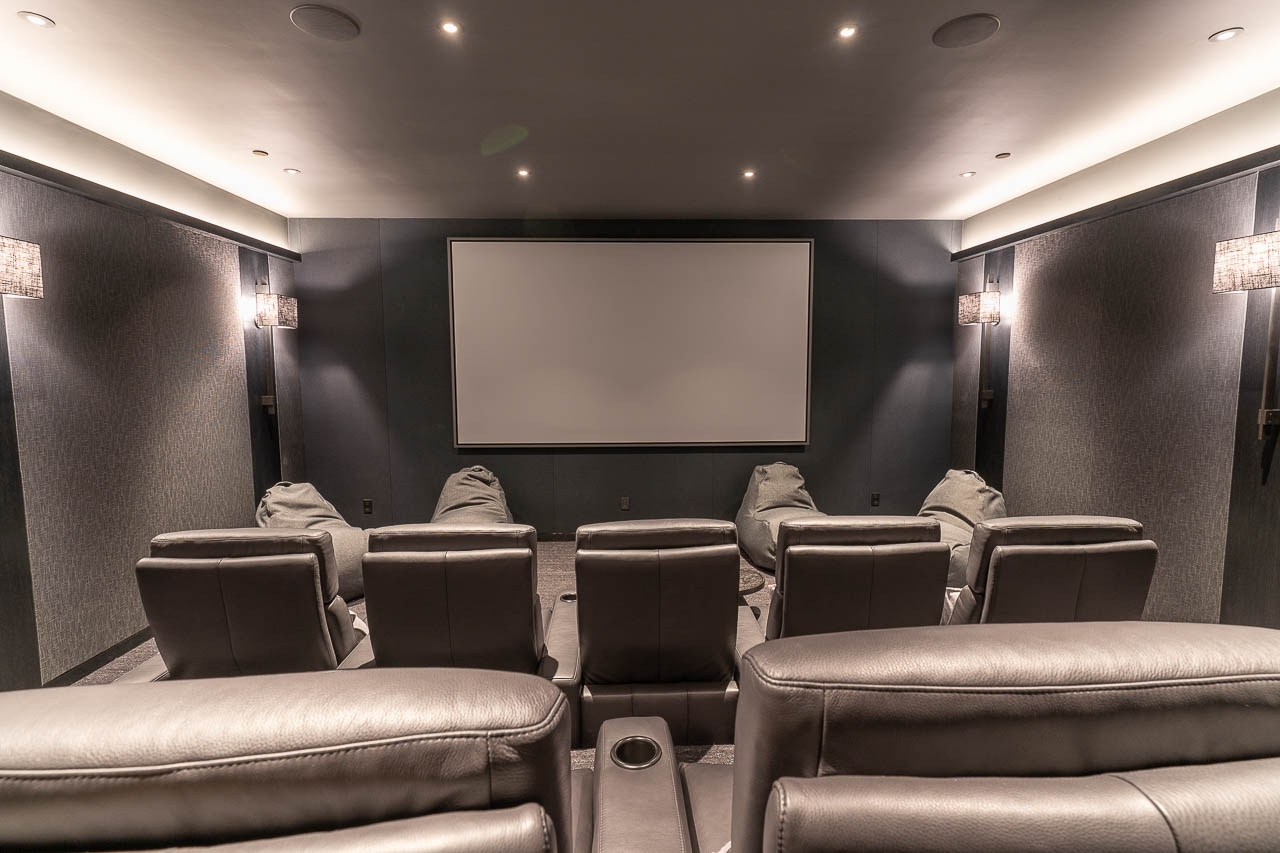
Dedicated theaters require some form of lighting control. Most of our theaters have three main lighting modes: all lights on, all lights off, and ambient lighting. The all-lights-on mode is used before and after movies to easily navigate the room. The all-lights-off mode is for maximum immersion — the only glow will be from the picture in front. The ambient lighting mode is somewhere in the middle.
The ambient lighting creates a small amount of light that doesn’t disturb the picture, but allows people to move around the room. There are low-brightness lights on stairs and pathways to the exit to let people see where they’re walking if they need to leave mid-movie. Sometimes sconces and other lights are also at low brightness. It’s entirely up to the designer. If you have all your friends over to watch a movie and someone needs to use the restroom, ambient lighting on the steps at a low brightness can help that person get out safely without disrupting everyone else.
The all-on and all-off modes can be triggered from the universal remote. Without lighting control, someone would have to turn off all the lights, walk to their seat, and then start the movie.
Bring It All Together with the Perfect Projector
Thankfully, the projector is one of the easier decisions for your home theater setup. When considering the right premium projector, there are only a handful of differentiating features: brightness, color vividness, and contrast.
You can get buried in spec sheets comparing projectors. However, the best choice is usually to pick one that matches the quality of the products you chose for the rest of your theater. If you chose good speakers for your audio, we’d recommend a good premium projector. If you picked the best speakers for your sound system, we’d recommend the best projector out there.
Designing the Room for Comfort
We want to make sure your custom cinema is a space you enjoy spending time in beyond the movie. If you are working with a designer, we’ll work with you and your design team to make sure the space is aesthetically what you’re looking for. However, the overall look of the theater is only half the equation. The other half is seating.
Seating for Long Binge Sessions
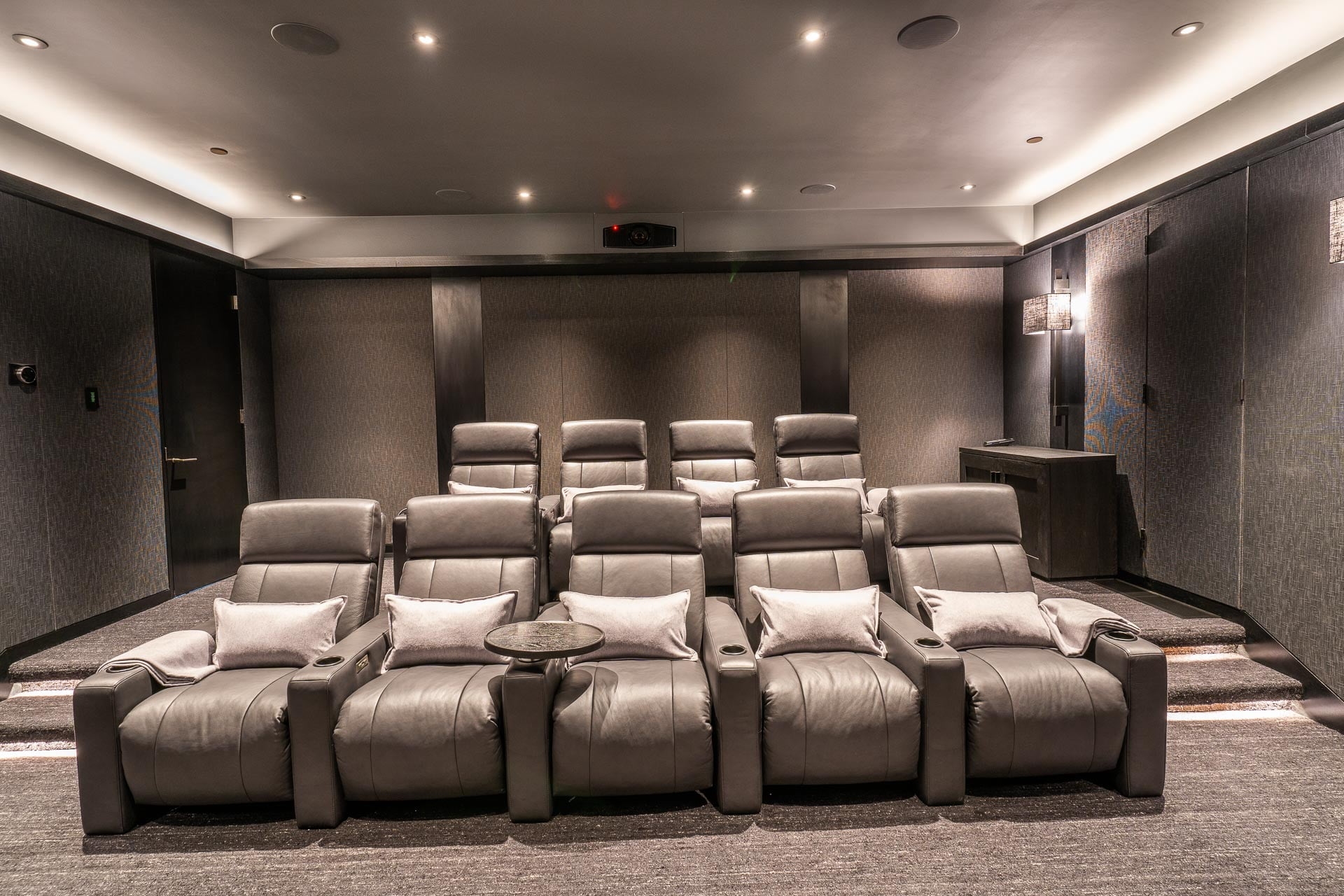
The right seating will keep you comfortable and relaxed throughout your longest movie binges. Unlike traditional chairs, purpose-designed home theater seats prioritize long-term comfort to minimize fatigue and discomfort during extended movie sessions. That means these seats offer unique features for optimal support, including lumbar and headrest features. Although we feel the immersion is captured best by a good audio and screen setup, those chasing that extra layer of immersion can use motion chairs. The right seating choice will help pull you into your cinematic journey right from the comfort of your own home.
Spaces That Still Look Great
Another critical piece to a high-quality private theater is the aesthetics. Earlier, we mentioned all the soundproofing in the walls and ceiling. Even though this is a dedicated theater, this room must look polished. The easiest way to do this is with acoustically transparent fabrics. We can place them over your speakers and soundproofing. These fabrics come in many colors and different design styles, allowing your designer to create an aesthetic that fits your style.
The ceiling speakers need a similar treatment. Most ceilings are not covered in fabric. Instead, we use a color-matched grill or a small aperture speaker to minimize the aesthetic impact. Mounting the speakers up in the ceiling does require some additional work: the speakers in the ceiling need a soundproof box to prevent ambient sound from leaking in.
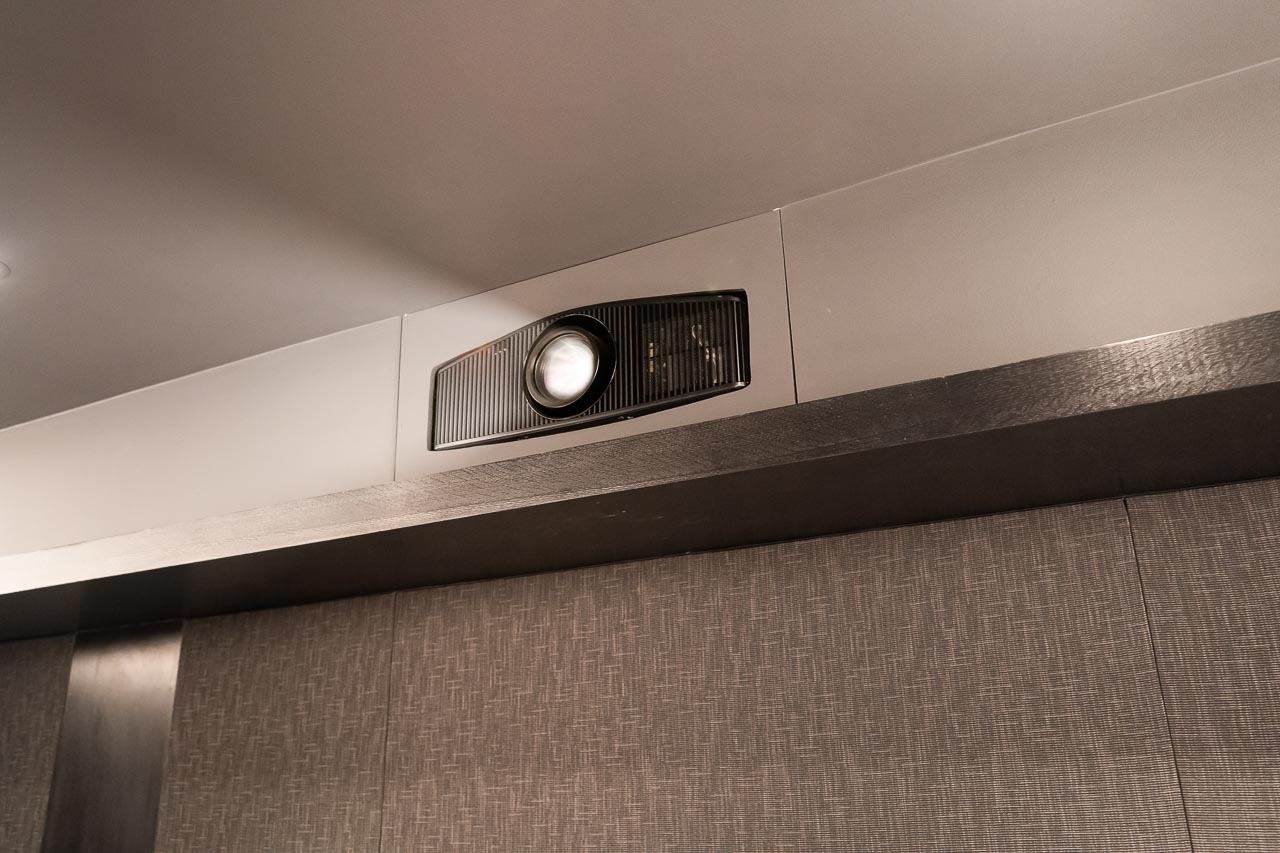
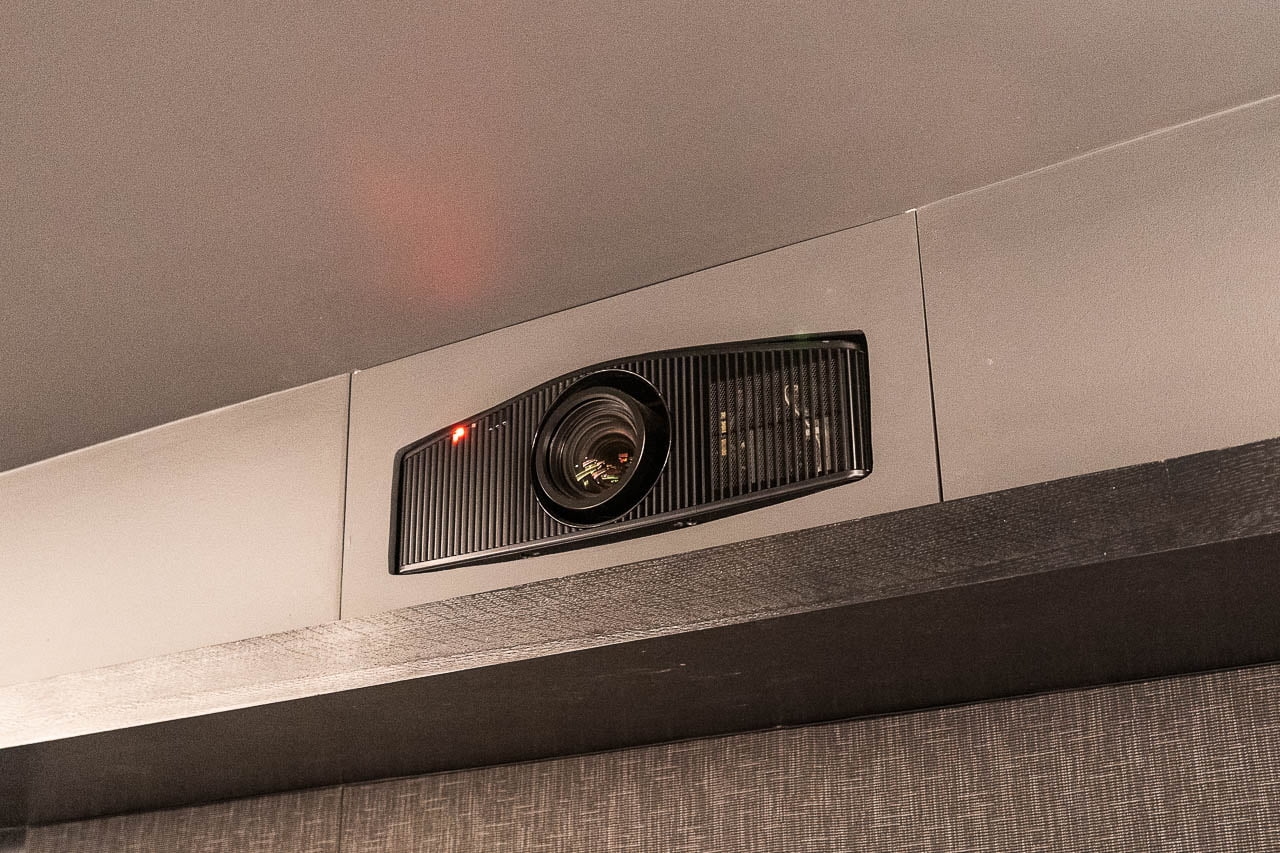
The final part is also hiding the projector. We recess the projector into the wall and only leave a small opening for the light to come through. Just like with speakers, the projector needs a soundproof box and enough ventilation to keep it from overheating.
Advanced System, Easy Control
Up to this point, we have a beautifully designed home theater space with all the equipment we need to begin watching, but now we need a way to control it all. This is where a home control system comes in. Traditional IR remotes won’t work now that the equipment is in a different room and the projector is behind the viewer. We use these control systems to turn on equipment in the correct sequence every time. That means when you want to start watching, it turns on the projector, lowers the screen if it’s motorized, turns off all the lights, and switches to the correct input.
Getting Your Own Custom Theater
Our engineering and obsessive attention to detail help deliver a theater experience surpassing some of the world’s best public theaters. Do you have more questions, or are you ready to get started with designing your transformative theater? We have done dozens of residential home theaters throughout the San Francisco Bay Area.
If you can’t commit to dedicating an entire room for a dedicated theater, many of our customers have opted for a hybrid theater. Hybrid theaters transform an ordinary room into a home theater at the press of a button. No matter what theater system you want to put in your home, you can give us a call at 415-456-7000 or leave us a message online. We are here to help bring your dreams to life, so feel free to reach out to us.
Start with the home theater page, see the source we specify for every performance room in Kaleidescape, or read how we isolate and treat a room before a single speaker goes in.